We are excited to be exhibiting the work of Newcastle College students in Newcastle-under-Lyme. The seats created can be seen in the windows behind the ex-Dorothy Perkins store at the Roebuck Centre.
Stacey Rowell, Curriculum Leader Extended Diploma in Art and Design:
We are always looking for our students to experience live briefs and collaborations with artists, so were thrilled when we were asked to collaborate with Dust Rising on the ‘Every other seat’ project. This is such an important and innovative project, the students were genuinely excited about being involved. They were put into small groups to initiate ideas and produce a final chair that represented their collaborative response to the theme. They have produced some fantastic work. We are so impressed with the diversity produced and some of the depth of consideration given to the theme. We are all looking forward to seeing their work as part of the display in town. This has been an invaluable experience for the students.
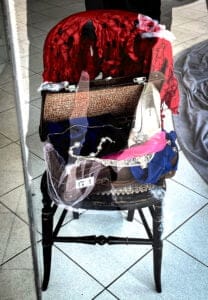
‘The Forgotten Performance’
by Jessica Waltho, Grace Wardle & Georgina Edge
During the Pandemic many arts venues suffered tremendously as they had to “temporarily shut”. We wanted our chair to showcase the effects that Covid-19 has had on theatres.
We didn’t want our chair to seem like it was adapting to the new environment that is Covid-19: we wanted the chair to embody how the stage has been abandoned as if everybody had been removed in an instant.
The inspiration from our chairs comes from the deserted aspects of the theatres and the way it presents how people, such as the government, have given up on them.
We chose to show this through the ripped curtains and cobwebs, but we also wanted to add an element of hope to the piece by having the lights still shining waiting to perform again.
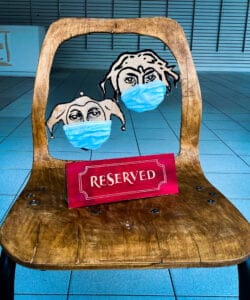
‘MASKRAID (mask-a-raid)’
by Felicity Gazy, Jasmine Cartledge-Riley & Jessica Copestick
The global pandemic has had a massive effect on the arts community and this project has allowed us to have a voice. We have used MASKRAID as a reflection of the struggling theatres and highlighting some of its aspects.
Interpreting the word mask in two different contexts;the use of protection and safety during the pandemic and the idea of disguise, hiding true emotions and making it difficult to differentiate between comedy and tragedy, therefore isolating people from each other both physically and emotionally.
Using the individual Regent theatre masks for inspiration allowed us to make a direct link to our local area, supporting the idea that anyone can be effected the consequences of the pandemic.
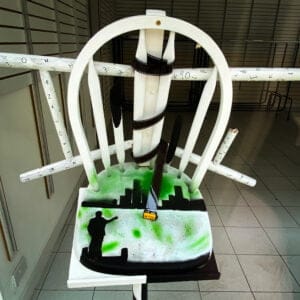
‘Suffocation’
by Oliver Ward, Abbie Flowers, Millie Price & Jess Goodwin
During the pandemic, people’s mental health is being affected. Using a vivid colour like green, we represent exactly how the virus is taking control.
When the government makes a speech it seems to never tell the true story. To show our interpretation of this we decided to rearrange the chair legs to make it look like a book.
Depending on where you stand to look at the chair you would get a different message. One side shows us being told what the government want us to know, however the other side represents what they really should tell us.
The ‘book’ standing proud shows the millions of people still going strong. Many people in the world feel trapped. White as the main colour represents purity and the freedom that everyone is craving.
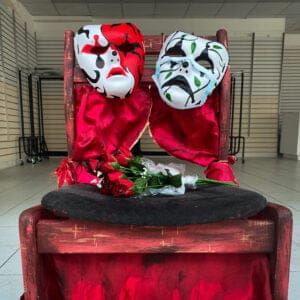
‘Cynthia’s Chair’
by Mari Spiliotopoulou, Maddie Jones & Aaliyah Cole
Our chair was designed to look old and abandoned. The seat was reserved but because of COVID-19 that chance was stolen away.
The chair itself is covered in old scars thatrangefromchippedpainttochunks of wood that has been scratched out of the chair.
During COVID many of the arts were just forgotten since you could not enter places like Theatres, museums and galleries. So we decided to show that through our chair by making it look unkempt, forgotten and left to rot all on its own, since people did not pay the arts any mind during the whole of lockdown.
The name Cynthia was really brought out of nowhere, but we decided to keep it since we all really thought the name reminded us of an elderly woman who liked to go to the theatre.
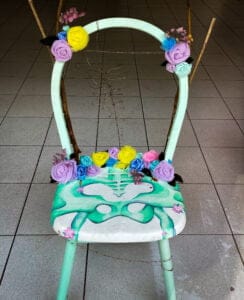
‘Life after Death’
by Courtney Wilson & Ellie Dimbleby
Our chair is based on coronavirus which is a difficult topic, but in a contrast we thought using a bright colour scheme to show happiness in a time where everything is quite dark would be effective.
The skeleton we painted on the chair represents the lives that have been lost due to the virus, to show the new life that death brings we made fabric flowers and added them onto the skeleton.
We added chains around the base of our chair to show the restrictions that have been placed around us, isolating us in our houses.
The wire skeleton that replaces the back of the chair shows how even in a tough time we can hold onto the ties between our loved ones, even without physically seeing them.
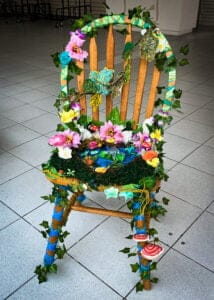
‘Growing Optimism’
by Maisie Tranter, Andreea Grecu & Tia McKeown-Speakman
Closed theatres, redundant performers not knowing when they will next be on stage, prop and costume makers all waiting for theatre goers to be re- seated.
We focused on the words abandoned, overgrown and possibly derelict, but added a magical fantasy element. Using the chair as if were a stage set we have entwined it with overgrown ivy, bright flowers using a mix of media.
Even though time has passed, and things begin to fade something pretty will grow from it, the brightly coloured plants and flowers reflect optimism and return to normality.
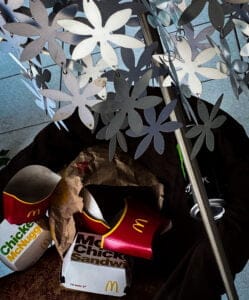
‘Home Cinema’
by Paige Hall, Romany Shone & Agata Jewasinska
Our chair is inspired by our lockdown experience. We did this by changing the demeanour of the chair, adding and covering it with fabric. However, we intentionally left the legs of the chair exposed to reflect the transition from entertainment chairs to our home sofas.
The imperfections on the chair represent it happening so fast that there were mistakes made while making the transition. The inspiration for this idea came from a survey that we devised when thinking about the entertainment industry replacing popcorn to fast foods and different deliveries.
We did this due to wanting people to have a relation to our own experience in lockdown. The lamp is to highlight this issue – it is without a power supply so is present but not working.
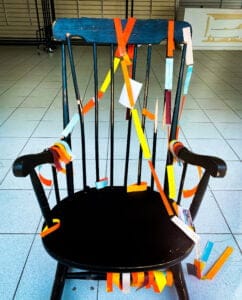
‘Rockin’ Chair’
by Chloe Manning, Macy Allender & Hannah Everill
Rocking chairs tend to be associated with pensioners sat fire-side, perhaps reflecting on a youthful past and energetic memories.
Our chair has been painted black to represent the slower and darker days of Covid-19 and the death of free movement, specifically live music events, cinema and theatre.
Colourful strips of paper signify festival wrist bands, ticket entry, ticker tape and fringed party curtains backdrop used for photo booths.
The bright paper strips are stapled and entwined around the black bars of the chair to reflect the glimmer of optimism of the lifting of lockdown restrictions allowing us to be young and free to rock again.
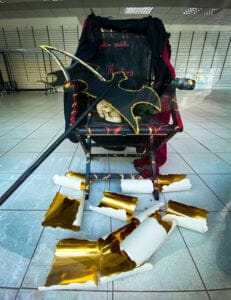
‘When there’s Death, there’s Paperwork’
by Lucina Belas, Jen Steel, Kristyna Paulova & Elise Gaunt
COVID-19 has become our constant companion and no doubt previous generations felt the same with any pandemic they faced.
The chair represents death during COVID-19 and we decided to take a modern twist on the Vanitas art movement incorporating their traditional ideas with contemporary items.
We felt that death would need a chair to sit in to do his paperwork and would naturally be surrounded by the accoutrements of his work.
His cloak is casually hung from the back of chair, his paperwork is strewn on the floor and the everyday ‘unnerving’ can be seen in the chairs handles.